
GCP-VOs Call for Applications: What to Submit (and How to Avoid Reporting Traps)

Public Safety Canada’s Grants and Contributions Program to Voluntary Organizations (GCP VOs)

⏱️ In one minute: In Public Safety Canada’s GCP-VOs, strong applications don’t just “sound good”—they’re deliverable. If your Workplan promises outputs like toolkits, manuals, curricula, or research-style reports, you need a realistic plan (and budget) to produce them—plus a simple evidence plan that starts on Day 1.


The deadline is close. This post is designed to help you submit a defensible package without accidentally setting yourself up for close-out problems later.

🚑 Need last-mile triage before you hit submit?
Our deadline-ready service is here: Rapid Grant Rescue

✅ Direct Answer 

To submit a strong GCP-VOs application, make your Workplan deliverables specific and achievable, budget for the real work of producing any promised guide/toolkit/report, and set up a practical evidence plan (KPIs + intake forms + cadence) that starts from Day 1.
📎 What to submit (the practical view)

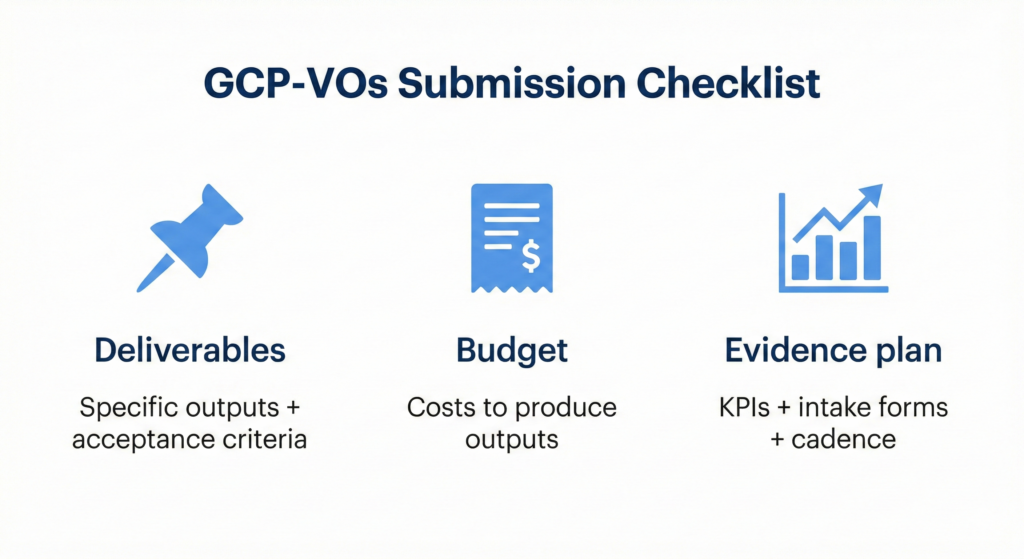
A strong GCP-VOs application is usually won or lost on three linked pieces:

📌 1) Your Workplan deliverables (the “what”)

List every output you are committing to deliver: services, sessions, cohorts, tools, manuals, reports, curricula, and any “products produced.”

🧾 2) Your budget (the “how”)

Budget for the work required to produce deliverables—especially knowledge outputs that take writing, review, layout, accessibility formatting, and sometimes evaluation support.

📊 3) Your evidence plan (the “proof”)

If you promise outcomes reporting (including GBA+ insights), you need a simple plan for what data you’ll collect, when, and how—starting Day 1.

Public Safety Canada GCP VO submission checklist

✅ The GCP-VOs submission checklist (use this before you upload)

📌 A) Deliverables clarity test

For every deliverable, can you answer:

  • ✅ What exactly is it? (manual, toolkit, curriculum, report)

  • ✅ What format will be submitted? (PDF / Word / slide deck)

  • ✅ What does “acceptable” look like? (outline, length range, required sections)

  • ✅ Who owns it internally?

🧾 B) Budget realism test

If you promised a product, do you have budget time for:

  • ✅ writing + review

  • ✅ design/layout

  • ✅ accessibility formatting (and translation, if applicable)

  • ✅ evaluation support (if a research-style output is promised)

📊 C) Evidence readiness test

If you promised a barriers study, outcomes report, or GBA+ insight:

  • ✅ do you have intake questions built?

  • ✅ do you have consent language + safe storage?

  • ✅ do you have a monthly data check scheduled?

Grant Application to Clean closeout

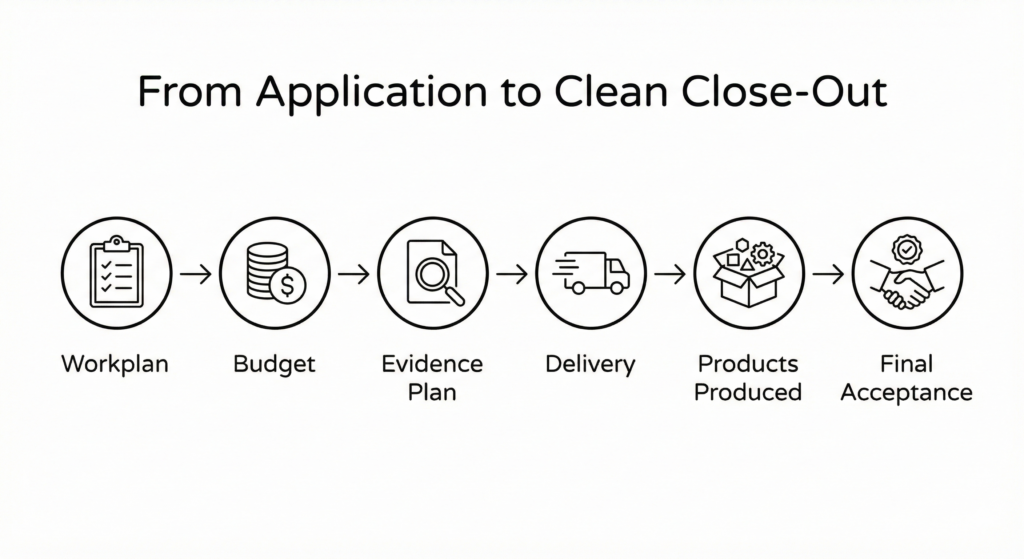
⚠️ The most common hidden risk: “products produced”

Many organizations assume “final reporting” is just narrative. But your file can also be judged on whether you produced and submitted the actual outputs you promised (manuals, curricula, guides, research-style reports).

🏁 Want to see how this fails in the real world?
➡️ Read the full case studies: Why Successful GCP-VOs Projects Fail at the Finish Line (Two Cautionary Tales)

🧩 Mini case previews (why this matters)

  • 🧩 The Missing Asset: A strong program… but the promised implementation manual wasn’t produced in a usable form, triggering an “incomplete deliverables” scramble.

  • 📊 The Data Vacuum: A promised GBA+ barriers report… but no disaggregated intake data was collected, so the report couldn’t be evidence-based.

👉 Full details: Why Successful GCP-VOs Projects Fail at the Finish Line (Two Cautionary Tales)

🚑 If you want a deadline-safe option

Rapid Grant Rescue (GCP-VOs): We stress-test your Workplan, deliverables, budget logic, and evidence plan so your application is defensible and workable after award.
➡️ Rapid Grant Rescue
📩 Prefer email? Contact us

Related Articles