
In one minute: The Canada Summer Jobs (CSJ) program is a wage subsidy grant from Employment and Social Development Canada (ESDC). It covers 50–100% of the minimum wage for hiring youth (ages 15–30). Success in the 2026 cycle depends on three things: strict adherence to the new “National Priorities,” submitting before the automated deadline, and ensuring your payroll system can pass the compliance audit.
Warning: CSJ is a high-volume program with automated screening. If your application does not explicitly tick the boxes for “National Priorities” or misses the deadline by even one minute, you will be screened out. Post-award, failure to separate grant funds from general operating cash often leads to audit confusion.
What is the Canada Summer Jobs Program?
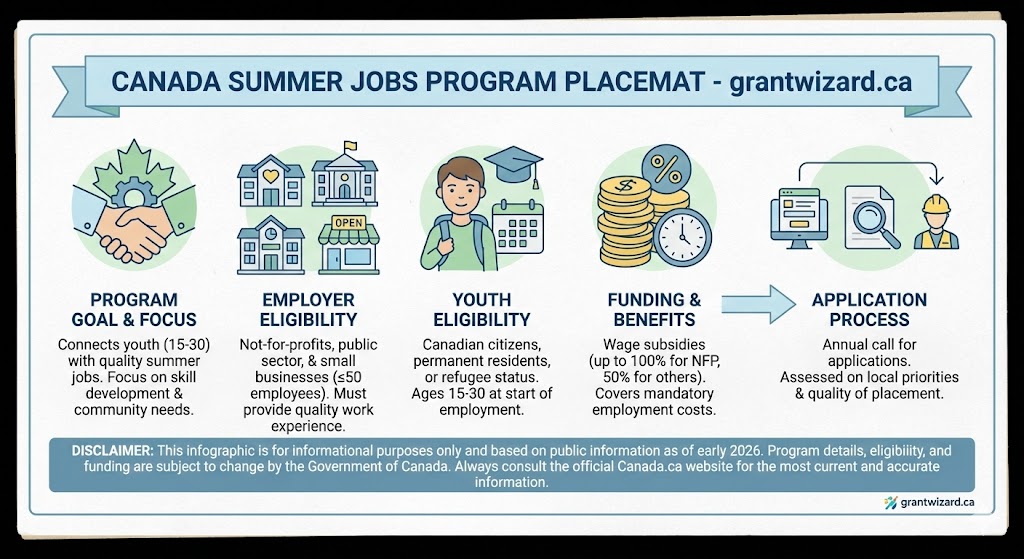
Direct Answer: Canada Summer Jobs (CSJ) is a federal initiative that provides wage subsidies to employers—primarily nonprofits, small businesses, and public sector organizations—to create quality summer work experiences for young people.
It is not just “free money” for hiring; it is a Contribution Agreement. This means you are signing a contract to provide mentorship, supervision, and a safe work environment in exchange for the subsidy.
Who this is for
Nonprofits: Eligible for up to 100% wage subsidy + Mandatory Employment Related Costs (MERCs).
Public Sector (Municipalities/Schools): Eligible for up to 50% wage subsidy.
Small Businesses: Eligible for up to 50% wage subsidy.
Requirement: You must have the capacity to supervise the youth and the cashflow to pay them (claims are often retrospective).
3 Steps to a Compliant Application
1. Align with the “National Priorities”
Every year, ESDC publishes a list of National Priorities (e.g., supporting youth with disabilities, Black and racialized youth, or small business recovery).
The Strategy: Do not just write a generic job description. Explicitly state in your narrative how this specific role supports one of those priorities.
The Detail: If the priority is “Green Jobs,” explain exactly how the student’s daily tasks contribute to environmental sustainability.
2. Confirm the “Quality of the Job Placement”
Service Canada officers review whether the job provides real skills, or if it’s just “cheap labour.”
Supervision: Name the supervisor and their qualifications.
Mentorship: Define the mentorship plan. Will there be weekly check-ins? Career coaching?
Safety: Confirm your health and safety policies are in place before you apply.
3. Prepare Your Payroll and Tracking
If you win, you will sign a Contribution Agreement. This is a legal contract.
Tracking: You must track the student’s hours exactly (sign-in/sign-out sheets).
MERCs: For nonprofits, the grant often covers Mandatory Employment Related Costs (EI, CPP, Vacation Pay). Ensure your payroll software splits these out clearly.
Pro Tip: The “Constituency Trap” for Multi-Site Orgs
Context: CSJ funding is allocated by federal riding. Service Canada officers assess applications based on the local MP’s priorities for that specific community.
The Risk: If you are a large nonprofit or have branches in multiple cities, you cannot submit one bulk application. You must submit a separate application for each physical location where a student will work. We often see large organizations scramble 48 hours before the deadline when they realize their “one application” is actually 15 separate administrative projects.
The Fix:
Map your Postal Codes: Use the Elections Canada tool to identify the federal riding for every office location before you log in.
Don’t Copy-Paste: While your job description can remain the same, your “Local Benefit” narrative must change to match the specific priorities of that riding’s MP.
Allocate Time: Budget 2–3 hours of data entry per constituency, not per organization.
Common Pitfalls
-
Applying for ineligible roles: You cannot hire immediate family members or use the funds for existing roles (displacement).
-
Ignoring the “local” priorities: MPs often have local priorities for their constituency. Check if your riding has specific focus areas.
-
Cashflow gaps: You typically pay the student first and get reimbursed later. Ensure you have the working capital to float 4–6 weeks of wages.
Reviewer Lens: The Audit Trail
When you claim your final payment, Service Canada may ask for proof of payment (cancelled cheques or direct deposit logs) and timesheets signed by both the student and supervisor. Set up a “Grant Folder” now. If you can’t prove the hours were worked, you will have to pay the money back.
Stop Reacting to Deadlines.
The Canada Summer Jobs program is just one line on a busy grant calendar. If you find yourself scrambling 48 hours before the deadline every year, you don’t need a writer—you need a roadmap.
Get the 2026 Funding Pipeline. We build your organization a custom 12-month grant schedule. We identify the high-value grants you are actually eligible for (Federal, Provincial, and Foundations), map out the deadlines, and give you the templates to manage them without the panic.